iAlpha Talk to us

EXECUTIVE AI TRAINING

Your executives are being asked to approve AI they have never used.

A hands-on workshop for the people who own the processes. They learn to work with AI, then design the agents they want for their own work. Drafted with us. Owned by you.

Join the companies we have trained.

150+ professionals trained across our AI workshops
40+ agents designed by the people who would own them
  1. C-suite

    CEOs and COOs in the room themselves, not delegated down.

  2. Department heads

    The people who own the processes an agent would touch.

  3. Team leads

    The managers who would run an agent day to day.

  4. Team members

    The people whose own work an agent would change first.
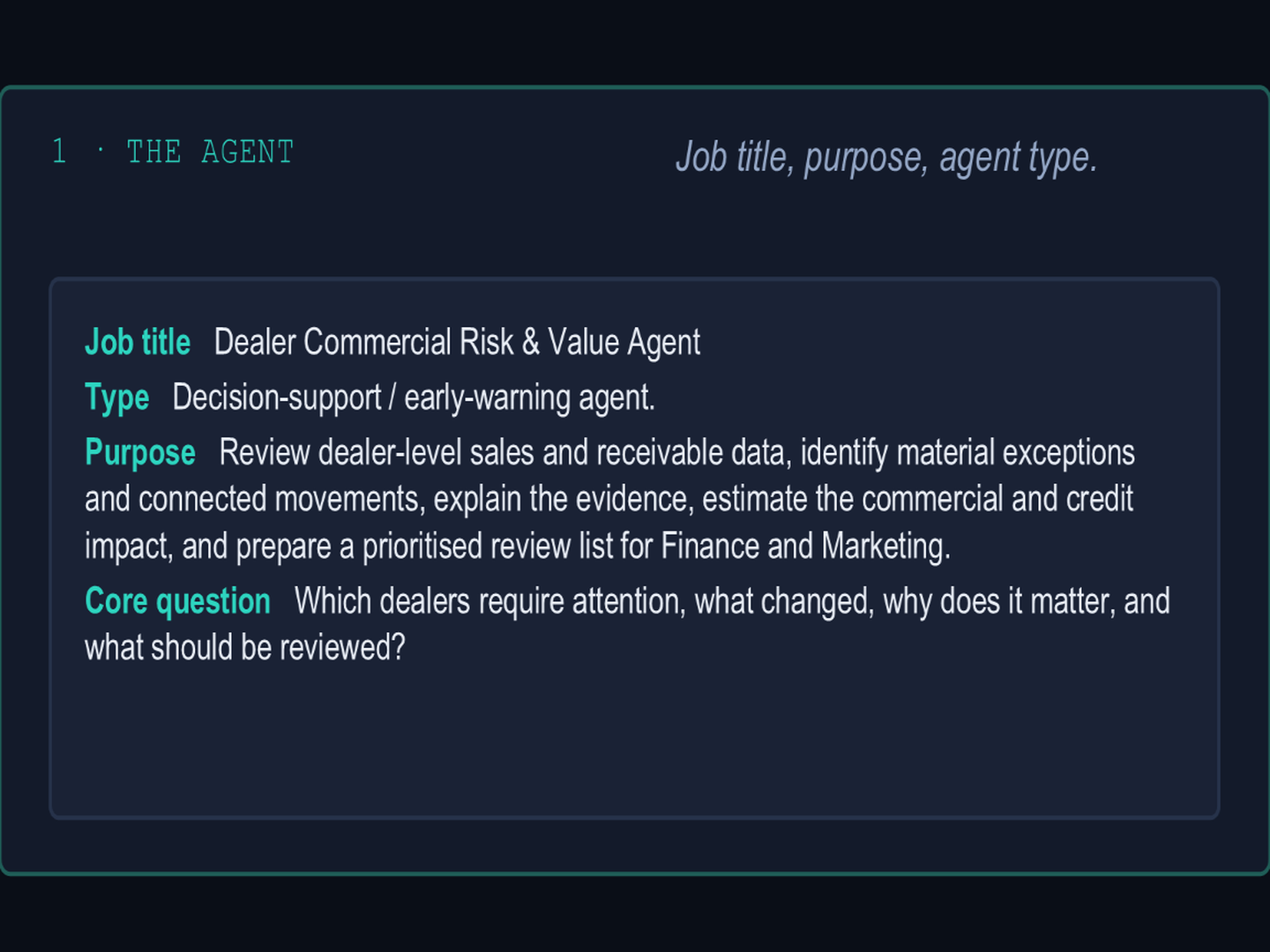
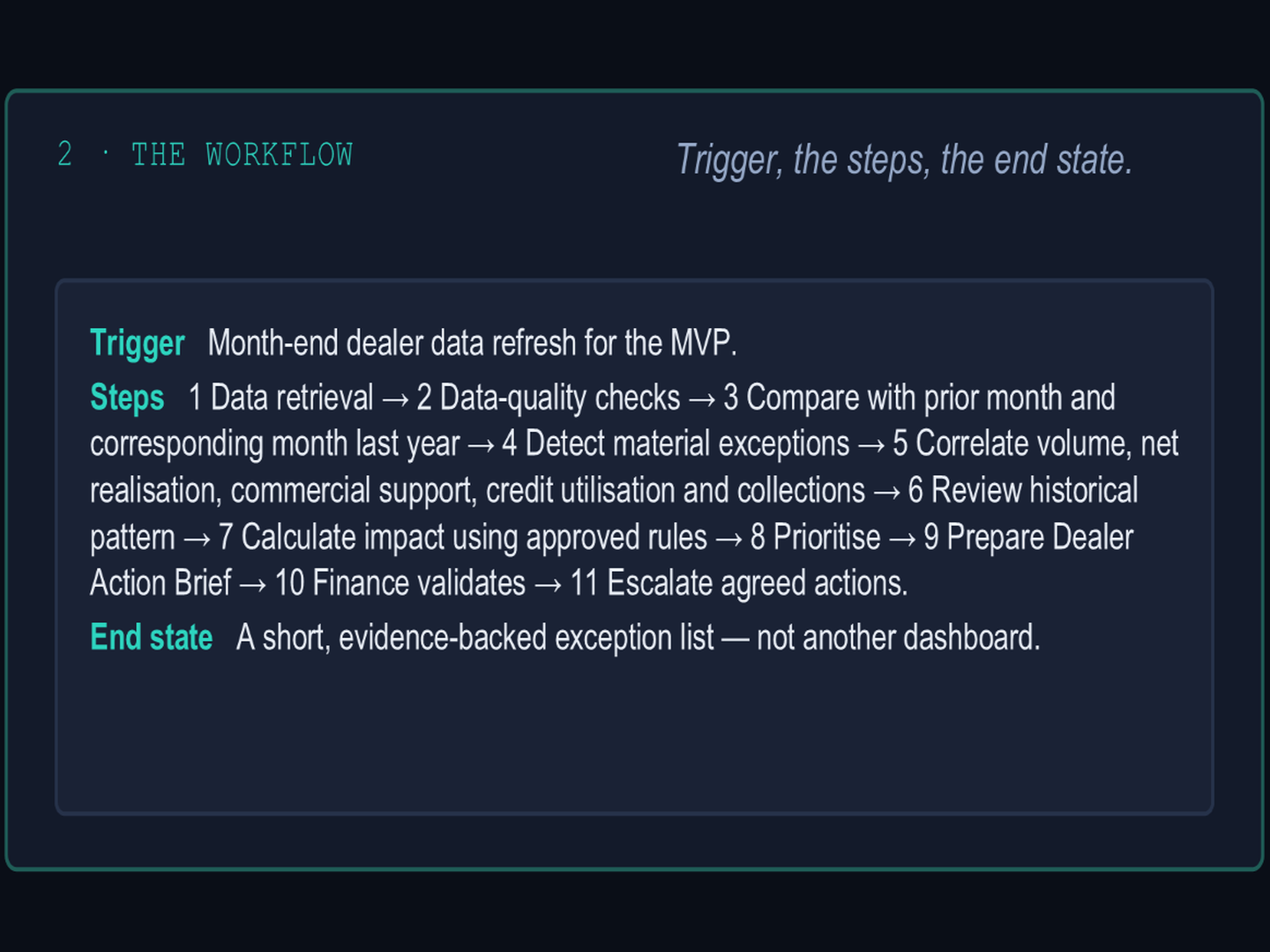
Box 1 of a participant group's agent canvas, The Agent: job title Dealer Commercial Risk and Value Agent, a decision-support and early-warning agent, with its purpose and the core question it answers.
They wrote the agent’s job description.
Box 2 of the same canvas, The Workflow: the trigger is the month-end dealer data refresh, then eleven steps from data retrieval and data-quality checks through detecting material exceptions to escalating agreed actions, ending in a short, evidence-backed exception list rather than another dashboard.
Then the workflow, step by step.
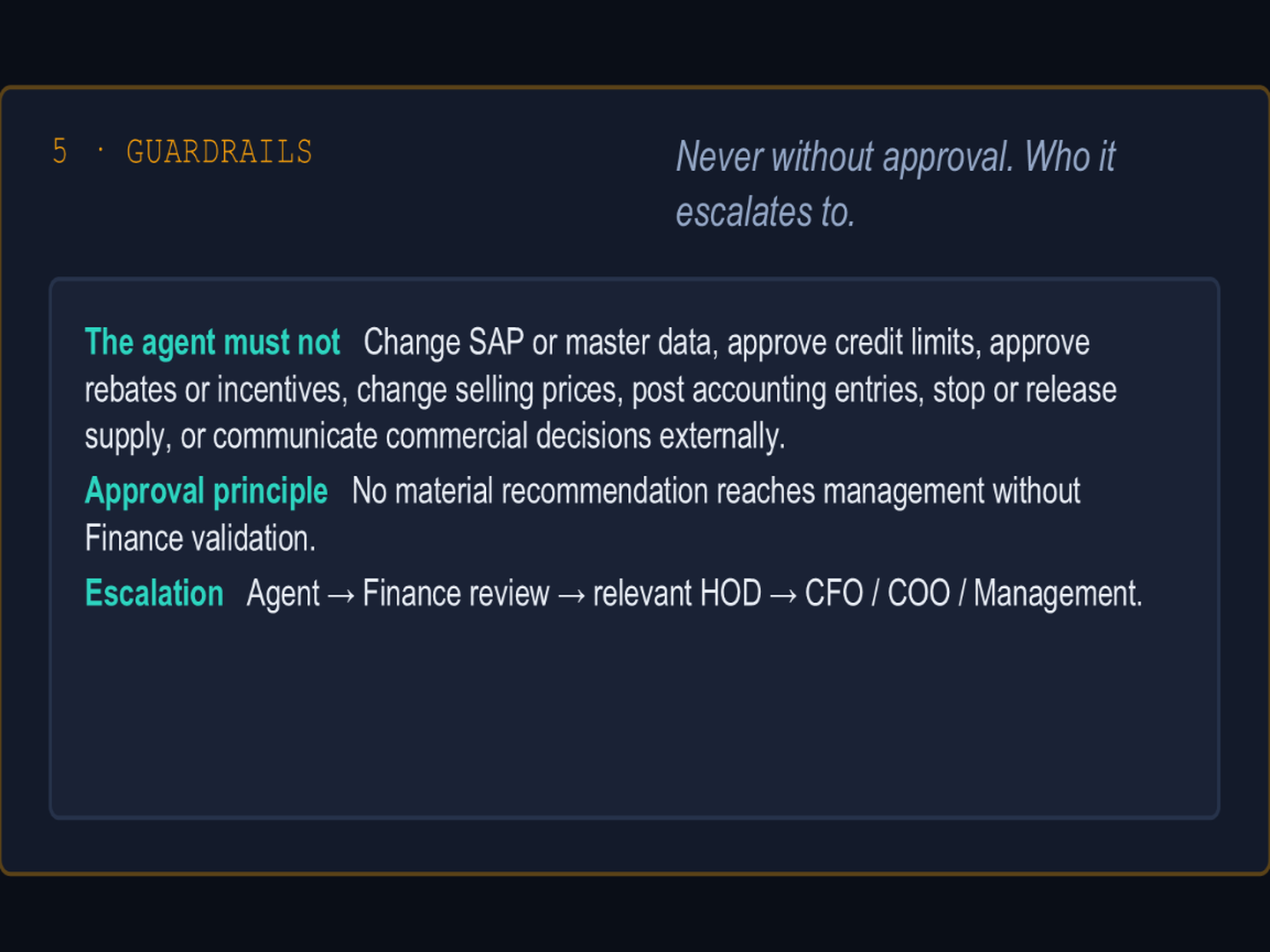
Box 5 of the same canvas, Guardrails: the agent must not change master data, approve credit limits or rebates, change prices or post accounting entries, and no material recommendation reaches management without Finance validation.
And what it must never do without approval.
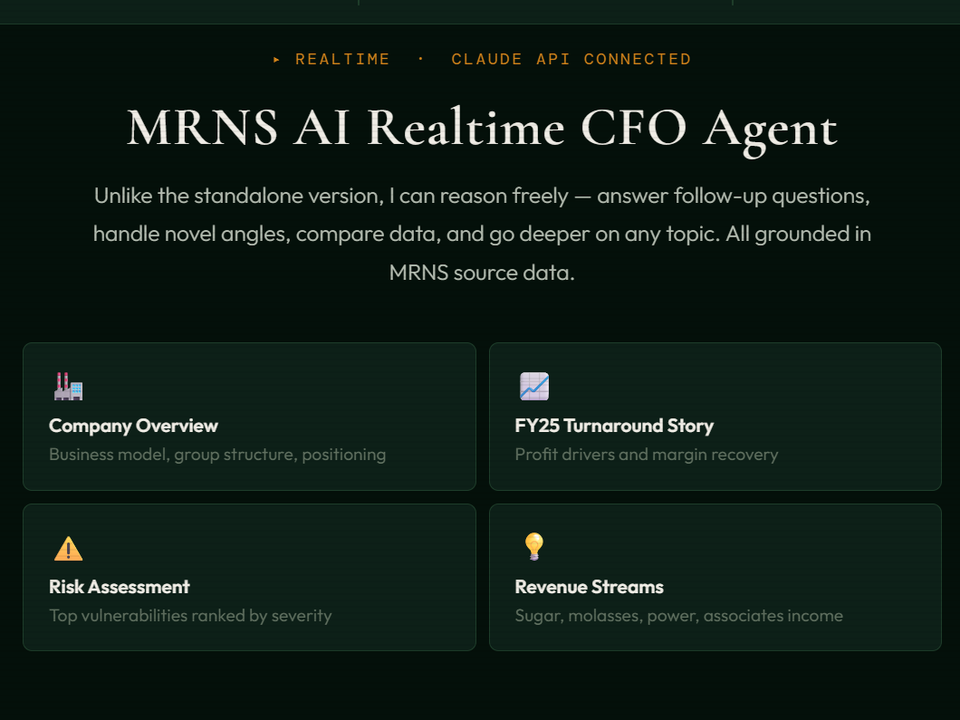
The opening screen of an AI CFO agent built for Mehran Sugar Mills, offering a company overview, the FY25 turnaround story, a risk assessment and revenue streams.
The AI CFO we built for sugar, shown in that mill’s session.
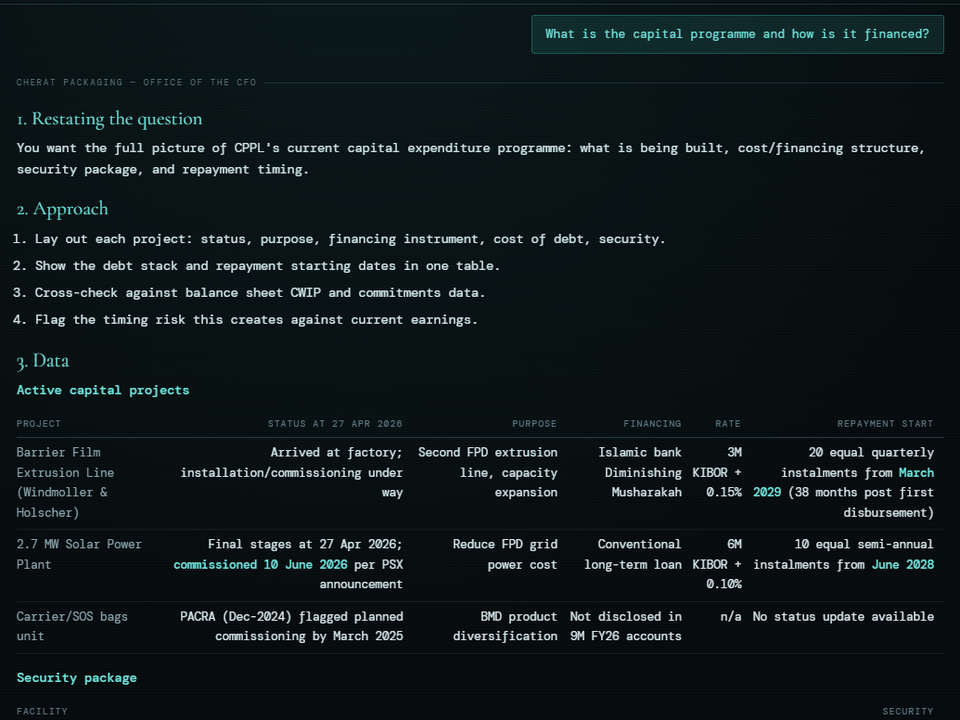
An AI CFO agent built for Cherat Packaging answering the question of what its capital programme is and how it is financed, with a table of active capital projects.
Rebuilt for packaging, answering from the published accounts.

Four moves. Nobody watches a slide for six hours.

Most AI training is a deck and a Q&A. People leave impressed, and on Monday nothing about how they work has changed.

  • Know what it can do, and can't.

    AI is not one thing, and the differences are what decide whether a project works. What it genuinely does well, what it still cannot do, and why it fabricates so confidently, plus the rule that protects you: never trust, always verify.

    You will know which kind of AI a problem actually needs.

  • Arm your AI for your job.

    Most people open an AI tool and start typing, and get generic answers back. You write your own custom instructions built for your job description, and learn a prompting structure that holds up against your real weekly tasks.

    Nobody leaves the room unconfigured.

  • Do your own work, not a demo.

    A memo, a variance, a decision you have been avoiding. From your own week, done and reviewed live, in front of the room. You build the AI into how that task actually gets done, so the second time nobody has to help.

    One real task from your own role, finished before you go home.

  • Design an agent. Then defend it.

    One process you own: what moves, what stays human, the data it needs, what it may never do without approval. Then you defend it in front of the room: the same interrogation it would get from your board.

    You learn how an agent actually works by having yours taken apart.

Three formats. Same method, different depth.

  • One day · on site

    Learn the method.

    The four moves in one day. Everyone configured, and one real task finished with AI.

    Best for
    A leadership team, or a whole department, that keeps being pitched AI and needs to judge it for itself.
    You leave with
    Everyone fluent enough to judge AI for themselves, plus a first list of where it would actually help in your business.
    Delivered for
    Ghulam Faruque Group · Mehran Sugar Mills
    What the day contains
    1. What AI actually is, and why 2026 is different
    2. Setting up your AI, with custom instructions written for your role
    3. Putting AI to work on your own tasks
    4. AI agents in action, demonstrated live on screen
    5. Responsible use
    6. Your one-week plan, and a written list of candidate agents

    You leave with a plan for the week after, with a date against each line.

  • Two days · on site Recommended

    Design the agents.

    Day one is the method. Day two your teams design agents for the processes they own and put them on trial in front of the room.

    Best for
    Teams who already know they want AI and need to decide what to build first.
    You leave with
    Real agents, designed and defended by the people who would use them. Specified far enough that building them becomes a decision, not a research project.
    Delivered for
    Cherat Cement · Cherat Packaging
    What the two days contain

    Day one

    1. What AI actually is
    2. Your AI co-pilot, configured and used hands-on
    3. AI for research, analysis and deep work
    4. Responsible use
    5. A day-one action plan

    Day two

    1. What makes an enterprise agent different from chat AI
    2. An agent gallery rebuilt for your business
    3. Ninety minutes designing agents for the processes you own
    4. Pitch and pressure-test, scored and taken apart by the room
    5. Data governance, and a ninety-day plan

    Ends with a ninety-day plan carrying named owners.

  • Four half-days · one morning a week

    Put it into practice.

    You try the work on your own week, then come back with evidence from it.

    Best for
    Releasing senior people without losing consecutive days.
    You leave with
    The habit: four rounds of learning and applying it to your own work, ending in costed cases built from what actually happened.
    Between sessions
    An assignment, each under an hour.
    What the four mornings contain

    Morning one

    1. What AI actually is
    2. Setting up your AI, with custom instructions written for your role
    3. The PREP framework for structured prompting

    Morning two

    1. What you tried in the week between, and what came back
    2. AI for research, analysis and deep work
    3. Responsible use, and your one-week plan

    Morning three

    1. What an AI agent actually is
    2. Two agents, seen end to end
    3. Agent ideas for your own business

    Morning four

    1. Designing your enterprise agents
    2. Building the business case
    3. Pitch and pressure-test, then governance and the ninety-day plan

    Ends with what the agents cost, what they return, and what would make you stop.

Customised for your business before it runs.

The executives who run your processes have never been shown what AI can actually do. The specialists who know what AI can do have never run your processes. Neither one can write the specification alone.

Those three are what we change every time. They are not the limit. If something else about how your business runs needs to be in the room, ask us for it.

Your Sector

The worked examples, the data and the agent we build live all come from your sector.

Two Ghulam Faruque Group companies, both two-day sessions.

  • Cement: the room was shown an AI CFO built for cement.
  • Packaging: the room was shown one built for packaging.
  • The method: identical both times. Only the sector changed.

Your Room

How much of the day is personal productivity and how much is governance is set by who is sitting in it.

Agreed with you before the day is built.

  • Executives: their own use of AI, then governing it and managing people who work alongside it.
  • Middle managers: bringing AI to a team: which agents it needs, and how to oversee people using it.
  • Everyone else: personal productivity, almost entirely. Being faster at the work they already own.

Your Function

Every example, every exercise and every case is rewritten for the function in the room.

A client asked for the one day for their finance team only.

  • The examples: variance analysis, board memos, forecast scenarios, audit preparation.
  • The tools: NotebookLM dropped. Excel and Sheets given a segment of their own.
  • The room: capped at 20, smaller than we normally run, with a case study written for nobody else.

Run by the founders. Not by a trainer.

Neither of us is an engineer by training. We came to AI from business, which is why the day is spent on what it changes in your processes, your reporting and your margins, not on how the technology works.

When someone asks whether the agent they have just designed could actually be built on their data, for a number they could defend, the answer comes from someone who has built one.

Saud spent twenty-five years across global enterprises from Boston to Karachi: Citigroup, PwC, FIFA, General Motors, Dow Chemicals and SK Telecom. Zayed builds what rooms like yours design: workflow mapping, data audits, agents and RAG pipelines.

Saud Hashimi

Princeton · Harvard Business School

Cofounder & Chief Executive Officer

Leads the room: the four moves, the agent design exercise, and the challenge your team gets when they pitch what they have built.

Zayed Hashimi

IBA

Cofounder & Chief AI Officer

Delivers the day with him: presents the agent sections, works the room through real cases, and takes the questions as they come.

The people on your first call are the people in your workshop.

We recommend two days. Day two is where the agent actually gets designed.

One of the founders reads your message. Not a coordinator. You'll hear back within two working days.

  1. A call. What your team does, what you want out of it, and whether the format fits.
  2. A proposal written for you. Tailored to your business, with a venue and a date.
  3. A final walkthrough of the plan and the coordination, then the workshop.

Or reach us however is easiest:

  • Both founders are in the room for every session.
  • We rebuild the day for your sector before it runs.
  • We work globally, from the United States and Pakistan.